
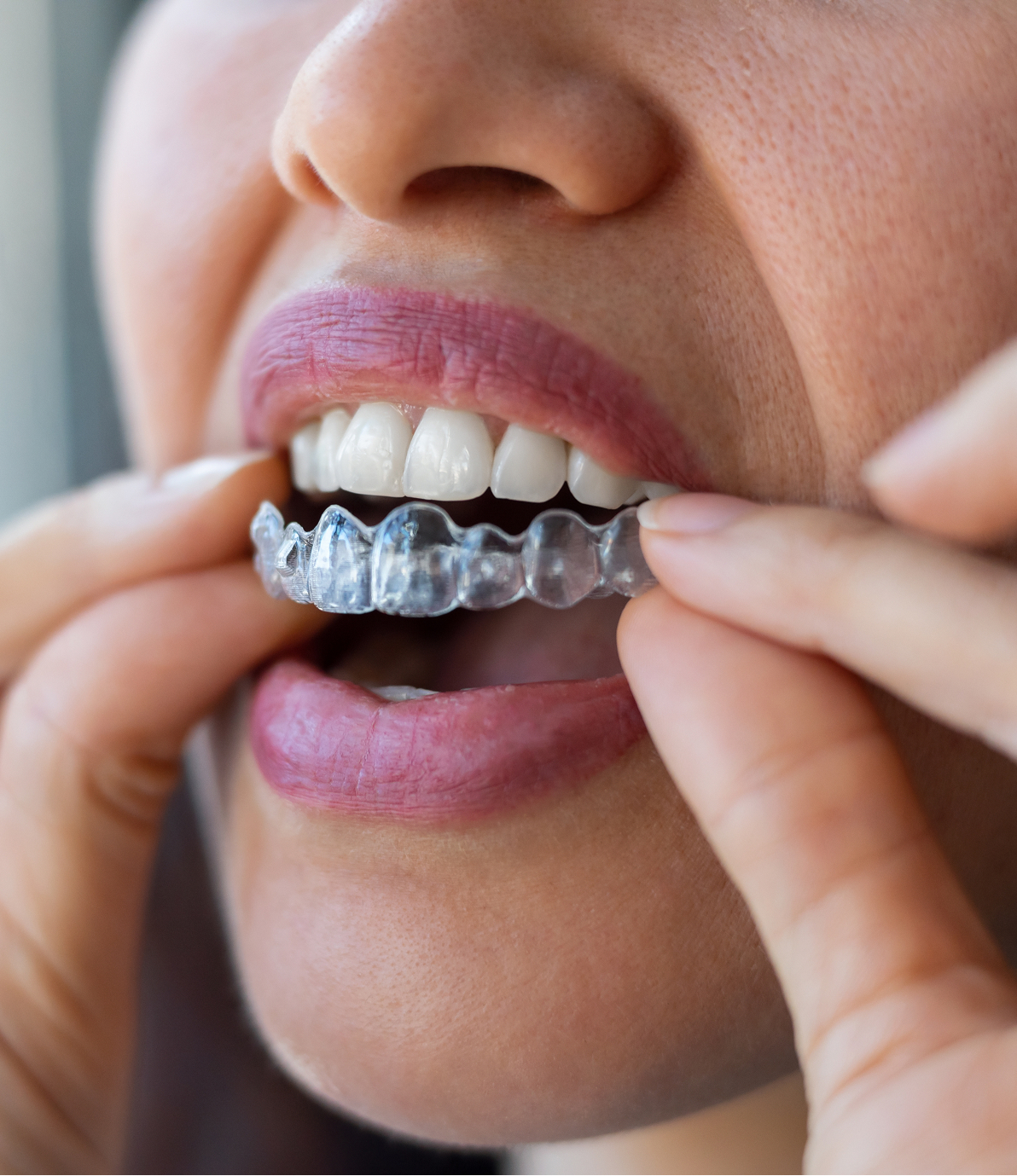

What clear aligners actually cost across Melbourne and the Mornington Peninsula, and the things that push your quote up or down.
Across Melbourne, Invisalign starts at roughly $4,500 for a short Lite or Express case and reaches about $9,500 for complex full-arch Comprehensive treatment. If your crowding is mild to moderate, expect a quote somewhere near $6,000 to $7,500. What you actually pay depends on how complicated your case is, and we can only confirm that once we have scanned your teeth.
How much does Invisalign cost in Melbourne?
Between $4,500 and $9,500 in 2026, and the gap between those two numbers is mostly a question of complexity. Published local guides put Invisalign Lite or Express at $4,500 to $6,000 for mild cases, with full Invisalign Comprehensive treatment reaching $7,500 to $9,500 (Aesthetik Dental, 2026 Melbourne guide).
Here is a simple guide to the tiers we see most often.
| Treatment type | Indicative cost | Who it usually suits |
|---|---|---|
| Invisalign Express / Lite | $4,500 to $6,000 | Minor crowding or spacing, short cases, relapse after previous braces |
| Average moderate case | $6,000 to $7,500 | Most adults with mild to moderate crowding |
| Invisalign Comprehensive | $7,500 to $9,500 | Moderate to complex cases, full-arch correction, bite changes |
Prices are indicative and correct at the time of writing; your exact fee is confirmed at your consultation.
The fee usually bundles your ClinCheck plan, your aligners and your review visits. Always ask what a quote includes, because retainers and refinements are not counted the same way everywhere. You can read more about our Invisalign treatment and book a scan at any of our six clinics.
What affects the cost of your Invisalign treatment?
No two mouths are the same, so no two quotes are either. A few things move the number up or down, and it helps to know them before you sit in the chair.
Case complexity does most of the work here. Small movements mean fewer aligners and less time in the chair, which keeps the fee at the lower end. Bigger jobs cost more because they take longer, whether that is closing a large gap or changing the way your teeth meet when you bite (your occlusion).
The number of aligners in your sequence follows from that complexity. A short case might run a handful of aligners. A full-arch case can run dozens.
Then there are refinement aligners. Sometimes teeth do not track exactly as planned, so we order a top-up set near the end to finish things properly. Some quotes include refinements and some do not, so it is worth checking.
Retainers get forgotten in a lot of quotes. Teeth drift. A retainer is what protects the result you have just paid for, so it belongs in the budget from day one. Ask us whether yours are included or billed on top.
Provider experience and provider tier can also come into it. Align Technology, the company behind Invisalign, groups dentists by how many cases they have completed. Those labels describe case volume rather than clinical outcome, so treat them as background and judge the clinician and the plan in front of you.
Finally, some people fold Invisalign into a wider smile plan with whitening or restorative work such as veneers or crowns. Bundling changes the total, and we will always set it out clearly so you can see each part. If you are weighing up all your choices, our orthodontic options page is a good place to start.
Invisalign treatment tiers, and who each one suits
There is no single Invisalign product. Align Technology sells several tiers, and the one you need is decided by your teeth rather than by a brochure.
Invisalign Express covers the shortest cases: very minor movements, a little relapse after braces you had years ago, or tidying up one arch.
Invisalign Lite goes a step further. It handles mild crowding or spacing that needs more than a handful of aligners, without turning into a full-arch project.
Moderate treatment is where most adults land. Mild to moderate crowding, a preference for something discreet, and a budget that has to make sense: this tier is usually the balance point.
Invisalign Comprehensive is the full course. It is designed for moderate to complex cases, full-arch correction and bite changes, and it usually builds in refinement aligners so there is room to fine-tune at the end. When a case genuinely calls for it, that is what we will recommend, even though it is the dearer option.
Which tier suits you is a conversation we have after the scan, once your ClinCheck plan is built. ClinCheck is the software your dentist uses to map every movement before the first aligner goes in.
How long does Invisalign take?
Six to 18 months, usually. The number is set by how far your teeth actually have to travel. Published Melbourne guidance puts an average moderate case near 12 months; the simplest work can be over in 3 to 6, and the hardest cases run 18 to 24 (Aesthetik Dental, 2026). Adults who come in with moderate crowding tend to finish somewhere in the 12 to 18 month window.
Your dentist will give you a realistic timeframe once your plan is mapped out.
One thing makes a genuine difference: wear time. Aligners work only when they are in your mouth. Plan on 20 to 22 hours a day, with them out only for meals, for anything you drink other than water, and for brushing and flossing. Wear them less, and treatment stretches out; the same guide estimates that wearing aligners only 16 to 18 hours a day can extend a case by roughly 20 to 40 per cent, so a 12-month plan can become 14 to 17 months.
Think of it as a partnership. We plan the movements; you keep the aligners in. Do that, and things tend to run to plan.
Does private health insurance cover Invisalign?
Sometimes, yes, but only if you hold the right cover. Orthodontic benefits sit under “extras” (also called general treatment), not under your hospital cover, and not every extras policy includes them.
Here is the part people miss. General dental extras usually cover check-ups, cleans, x-rays and small fillings. Orthodontics, which includes braces and clear aligners, is a separate, higher-tier benefit. If your policy doesn’t list orthodontics, it will not pay toward Invisalign.
Orthodontic benefits are usually capped by a lifetime limit rather than an annual one, and it commonly falls between about $1,500 and $3,500 per person (Townsville Dental Directory, reviewed by Dr James Chen, updated 9 June 2026). On top of that there is usually a 12-month waiting period before your first claim. Compare Club puts it plainly: “you’ll need to wait at least 12 months after taking out a health insurance policy with orthodontics cover before you can claim.”
One more trap: some policies cover traditional braces but exclude clear aligners. So ring your fund and confirm that clear aligners are included, that your waiting period is served, and how much of your limit is left. It helps to quote the treatment item numbers when you ask (for example, item 881 for braces and item 825 for aligner treatment). Our team can give you an itemised treatment plan with the details your fund will want. You can also read our payment plans and health-fund information.
Where you can claim, our HICAPS terminals let you process the rebate on the spot, so you only pay the gap. And to be clear about the public system: Medicare does not cover orthodontics for adults.
Payment plans and making Invisalign affordable
Paying for treatment in one hit is not the only way. Many patients spread the cost with a payment plan, and the usual shape is a deposit up front followed by regular instalments over the course of treatment.
The idea is simple. You start treatment now and pay it off in manageable amounts rather than waiting and saving first. Terms and eligibility vary, so the specifics are best sorted in person.
We would rather talk you through the current options face to face than print numbers that date quickly. Our reception team can walk you through what is available and what suits your budget. It is worth pairing this with any health-fund rebate you can claim, since the two work together to lower what you pay out of pocket.
Ask us at your consultation, and we will lay it all out plainly.
Is Invisalign worth the cost?
That depends on what you value. One way to frame it: an orthodontic result, looked after with retainers, can last many years, so spreading the fee across that time often works out to a modest cost per year.
Plenty of adults come to us for the discretion. Aligners are harder to spot than fixed braces, and that counts for a lot if you spend your days presenting, teaching or on camera.
Cleaning is easier as well. The aligners come out when you brush and floss, so your routine barely changes, whereas brackets and wires have to be worked around. Teeth that sit in line are also less fiddly to keep clean over the long run.
Invisalign is not the right tool for every case, and we will say so if braces would serve you better. Any orthodontic treatment carries some risk, and results vary from person to person, so we will talk you through the possible downsides before you commit.
Why choose The Smile Collective for Invisalign in Melbourne & Mornington Peninsula
Straightening your teeth is a decision you want to make with people you trust. Our dentists bring years of orthodontic and clear-aligner experience, and treatment is planned around your teeth, your bite and your goals.
Dr Fady Goher holds Invisalign Diamond Provider status and has a Diploma in Orthodontics and Dentofacial Orthopedics. Dr Ronak Patel and Dr Osman Ali are Invisalign Providers. All of our dentists are Australian Dental Association members, with experience across general, oral surgical and orthodontic care, and dental implant placement is available at our Mornington Peninsula clinics.
Across our clinics, we use CEREC same-day restorations, EMS Airflow Guided Biofilm Therapy, laser dentistry and a CBCT 3D scanner. Sedation and sleep dentistry are available for patients who find dental visits difficult.
You will find us at six centres: Greensborough, Mooroolbark, Oakleigh and Strathmore in Melbourne, and Mount Eliza and Mornington on the Mornington Peninsula. Whether you want Invisalign in Oakleigh or somewhere closer to the coast, a team is near you.
Book online, or ring the Smile Collective clinic closest to you.
Further reading
- Our Invisalign treatment: how clear aligners work and what to expect at your consultation.
- Orthodontic options: compare clear aligners, metal braces and ceramic braces.
- Payment plans and health-fund information: fees, funds and flexible payment options.
- Invisalign for younger patients : how Invisalign works, when it may be considered, and what is involved
Medical references
- Healthdirect Australia, Orthodontic treatments: https://www.healthdirect.gov.au/orthodontic-treatments
- Healthdirect Australia, Dental braces and retainers: https://www.healthdirect.gov.au/amp/article/dental-braces-and-retainers
- Better Health Channel (Victoria), Orthodontic treatment: https://www.betterhealth.vic.gov.au/health/ConditionsAndTreatments/orthodontic-treatment
- Better Health Channel (Victoria), Orthodontist service: https://www.betterhealth.vic.gov.au/health/serviceprofiles/orthodontist-service
- Australian Dental Association (teeth.org.au), Teeth Straightening and Braces: https://www.teeth.org.au/teeth-straightening-and-braces
- Cleveland Clinic, Dental Braces: Types, Uses, Care: https://my.clevelandclinic.org/health/treatments/24601-teeth-braces
- Invisalign Australia, how it works (SmartTrack and ClinCheck): https://www.invisalign.com.au/how-it-works/invisalign-digital-experience