
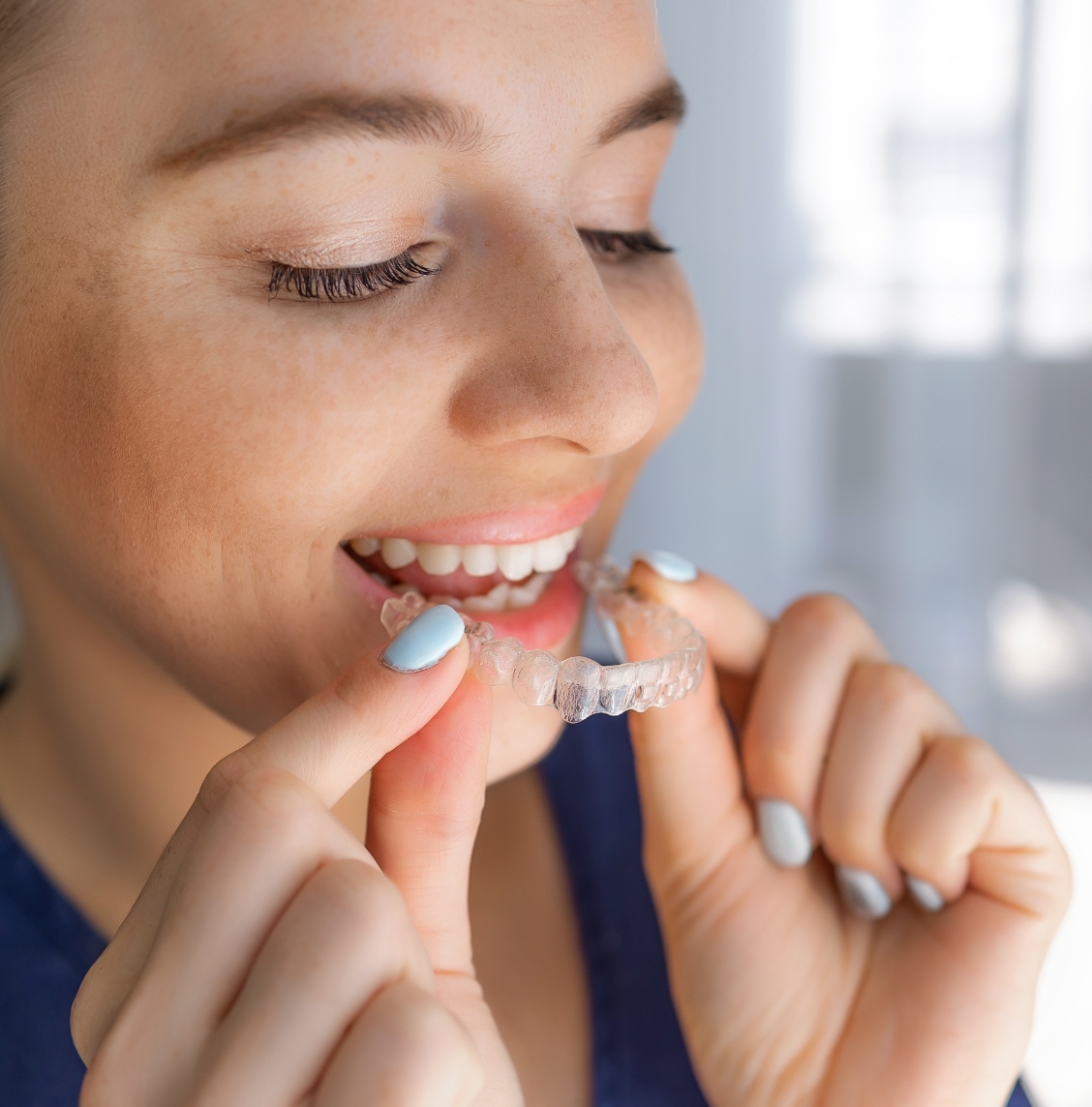

A clear comparison of clear aligners and braces on speed, comfort, cost and results, to help you choose with confidence.
Invisalign uses clear, removable aligners and suits mild to moderate cases, while braces are fixed and often better for complex bite problems. Both usually take about 12 to 24 months. Which one is right for you depends on how complicated your bite is, how you live day to day, and whether you will really keep aligners in for 20 to 22 hours.
Invisalign vs braces: the quick answer
Most people arrive at this question having already decided they want Invisalign, and hoping we will confirm it. Sometimes we do. Sometimes we do not, and the honest answer saves people a lot of money and disappointment.
Teeth move the same way in both cases. Light, steady pressure, kept up over months. The difference is what applies it: clear plastic trays you can remove whenever you like, or brackets and wires that stay on your teeth until we remove them.
Aligners are easier to live with, and almost nobody notices them. Braces hand us more control, which counts for a lot in a complicated bite, and they carry on working on the days you forget about them entirely. In our experience, that second part decides more cases than people expect.
The short version: for mild to moderate crowding or spacing, either usually works and it comes down to lifestyle. For complex bite correction, braces are often the stronger clinical choice.
Invisalign vs braces at a glance
| Factor | Invisalign | Metal braces | Ceramic braces |
|---|---|---|---|
| Appearance | Virtually invisible | Most visible | Less visible than metal |
| Removable | Yes | No | No |
| Typical treatment time | 12 to 24 months | 12 to 24 months | 12 to 24 months |
| Comfort | Smooth plastic, no wires | Wires can irritate | Wires can irritate |
| Suitable cases | Mild to moderate | Mild to complex | Mild to moderate |
| Oral hygiene | Easiest; remove to brush | Requires more effort | Requires more effort |
| Food restrictions | None; aligners removed | Yes | Yes |
| Retainer needed after | Yes | Yes | Yes |
One caveat on those times. They are typical ranges rather than promises, and a simple case of either kind can finish sooner. You will see shorter figures quoted for aligners elsewhere, and that mostly reflects aligners being used on easier cases, not plastic working faster than wire.
How Invisalign works, and who suits it
First comes the digital scan. We run a small wand around your teeth for a few minutes. No putty tray, so nobody has to sit there gagging.
The scan then goes into ClinCheck, the planning software Align built, and we use it to map each movement your teeth need to make. You get to see the projected finish before you commit to anything. One caveat, said plainly. That is a projection, not a guarantee, since teeth don’t always shift on schedule. It still beats guessing.
Your aligners are then manufactured from SmartTrack, the flexible plastic Align Technology developed for the system. You wear each set for one to two weeks, then swap to the next. Small tooth-coloured attachments are sometimes bonded to certain teeth to help trickier movements.
Now the part that decides everything. Aligners only work while they are in your mouth, and you need them in for 20 to 22 hours a day. Cleveland Clinic puts the figure at a minimum of 22 hours, out only for eating, drinking and brushing.
Invisalign generally suits:
- Mild to moderate crowding or spacing
- Mild overbites, underbites and crossbites
- Relapse after previous orthodontic treatment
- Adults who cannot have visible brackets at work
- Patients who will genuinely stick to the wear time
We mean that last one. If long lunches and slow weekends will leave your aligners sitting on a bench, braces will probably serve you better, and we would rather say so at the start than watch a twelve-month plan stretch to eighteen. Nobody is judging you. It is simply easier to plan around the truth. More detail is on our Invisalign clear aligners page.
How braces work, and who suits them
Braces have had decades of refinement. The brackets are smaller now, and a fair bit kinder on your mouth than whatever you remember from high school.
Each tooth gets a small bracket bonded to it, and an archwire runs across the lot. The wire wants to return to its original shape, and that steady tug is what moves teeth. At review visits, we swap or tighten the wire depending on what has moved. Because none of it comes out at dinner, the pressure never stops.
That is why we still reach for braces in plenty of cases. Fixed appliances tend to be the better clinical choice for:
- Heavy crowding, or teeth that need rotating a long way
- Awkward bites, including deep overbites and pronounced underbites
- Cases needing large vertical tooth movements
- Teeth that need to be moved through bone over longer distances
- Younger patients still growing, where jaw development is part of the plan
- Anyone who realistically will not manage aligner wear time
Metal braces are the most robust and usually the most economical. Ceramic braces use tooth-coloured brackets that blend with your enamel, so they are far less obvious at conversational distance while working the same way. Ceramic brackets are slightly more brittle than metal, and the clear elastic ties can pick up staining from coffee, tea and curry, so they need a bit more care.
Both need a little discipline: no hard or sticky foods, careful brushing around the brackets, and a mouthguard for contact sport. Our orthodontic treatments page sets out all the options.
Is Invisalign faster than braces?
Sometimes. Not dependably, though, and not because plastic beats wire. Most people finish somewhere inside 12 to 24 months either way, with easy cases done sooner and difficult ones running on.
Invisalign does come out ahead in straightforward cases with committed patients. A mild crowding case with excellent wear time can wrap up in six to twelve months.
The catch is compliance. Aligners worn 16 or 17 hours a day instead of 22 stop tracking to plan, and treatment stretches out or needs extra refinement aligners at the end. Braces don’t have this failure mode because you cannot take them out.
So the fastest treatment is not a product. It is the right appliance for your case, worn as instructed, with reviews kept. We will give you a realistic timeframe once we have scanned your teeth, not before.
What each option costs
The two land closer together than people expect. Plenty of patients arrive assuming Invisalign carries a hefty premium over braces.
As a rough guide for 2026, drawn from published Melbourne price ranges:
- Invisalign: about $4,500 to $9,500, depending on how complicated the case is and which treatment tier fits it
- Metal braces: roughly $6,000 to $9,000 for comprehensive treatment
- Ceramic braces: roughly $6,500 to $10,000, the ceramic brackets costing more than metal
For simple cases, Invisalign can cost less than braces. For complex full-arch work, it usually sits at the top of its range and metal braces become the more economical route.
Funding works like this. Medicare pays nothing towards orthodontics. If you hold extras cover with orthodontic benefits, expect a contribution of roughly $1,000 to $3,500, usually capped across your lifetime rather than each year, and usually only after a waiting period. Call your fund and ask about clear aligners by name rather than braces, because some policies cover one and exclude the other. Our payment plans and health-fund information page has the detail, and there is a fuller breakdown of how much Invisalign costs in Melbourne.
Prices are indicative and correct at the time of writing; your exact fee is confirmed at your consultation.
Comfort, lifestyle and maintenance
This is where the two genuinely diverge, and it is worth thinking through honestly before you choose.
- Comfort. Both cause some tenderness as teeth move. With aligners, it arrives for a day or two each time you change trays. With braces, it follows each adjustment visit. There is also the rubbing. Metal against the soft inside of your cheek takes a week or two to settle down, and smooth plastic never does
- Eating. Aligners come out, so nothing is off the menu. Braces mean avoiding hard and sticky food for the whole treatment: no toffee, no biting into apples or crusty bread, careful with nuts
- Cleaning. Aligners are the clear winner. You take them out and brush and floss normally. With braces, threading floss around wires is a genuine chore, and plaque builds up around brackets, so regular check-ups and cleans matter more than ever
- Appointments. Braces bring you back every four to eight weeks for an adjustment. Aligner reviews are usually quicker and spaced further apart, which helps if you travel for work or cannot easily get away in business hours
- Sport and speaking. When playing contact sport, you take the aligners out and put in a custom mouthguard. With braces, the mouthguard has to fit over the brackets instead. And if you talk for a living, aligners barely show, although expect a slight lisp for the first week while your tongue works out where the edges are
So how do you choose?
Three questions usually settle it.
- How complicated is your bite? That is a clinical question rather than a matter of taste, and a scan answers it. Awkward bites lean towards braces. Mild or moderate crowding leaves both doors open
- How honestly will you wear them? If 22 hours a day sounds like a struggle, braces will serve you better. There is no shame in knowing yourself
- What matters most day to day? Invisibility and eating freely point to aligners. Not having to think about it at all points to braces
Bring those answers to a consultation. We will scan your teeth, show you what is realistic with each option, and quote both where both are suitable. If we think one is clearly better for you, we will say so.
For younger patients, we have a separate guide to Invisalign for teens and children.
Why choose The Smile Collective for Invisalign and braces treatments in Melbourne and Mornington Peninsula
Choosing between aligners and braces is easier with someone who offers both and has no reason to push either.
Our dentists are all Australian Dental Association members, with experience across general, oral surgical and orthodontic work, and we place dental implants at our Mornington Peninsula clinics. Dr Fady Goher, BDSc ADC MFDS Edinburgh, is a Director and Principal Dentist who holds a Diploma in Orthodontics and Dentofacial Orthopedics (2015), and has Invisalign Diamond Provider status, a tier Align Technology awards on the number of cases a provider has treated rather than on registration or extra qualifications. Dr Ronak (Ron) Patel, BDS MJDF PGDip(Implants), is a Director and Principal Dentist, an Invisalign Provider, and is certified to treat dental phobia. Dr Osman Ali has completed a Graduate Diploma in Digital Orthodontic Treatments and extensive training in implant dentistry, and is currently undertaking a Master Clinician Program in Implant Dentistry. Meet the wider team on our About Us page.
Planning is digital from the start. We use intraoral scanning and a CBCT 3D scanner for treatment planning, alongside CEREC same-day restorations, EMS Airflow Guided Biofilm Therapy and laser dentistry. Sedation and sleep dentistry is available for patients who find dental visits difficult.
You will find us at six centres: Greensborough, Mooroolbark, Oakleigh and Strathmore across Melbourne, and Mount Eliza and Mornington on the Mornington Peninsula. Whether you want orthodontics in Oakleigh or somewhere closer to the coast, there is a team near you.
Book a consultation at your nearest clinic: Greensborough | Mooroolbark | Oakleigh | Strathmore | Mount Eliza | Mornington
Book online or call your nearest Smile Collective centre.
Further reading
- Invisalign Clear Aligners at The Smile Collective
- How much does Invisalign cost in Melbourne?
- Metal Braces and Ceramic Braces at The Smile Collective
- What should I know about Invisalign treatment for children?
Medical references
- Healthdirect Australia: Orthodontic Treatments
- Healthdirect Australia: Dental Braces and Retainers
- Better Health Channel (Victorian Government): Orthodontic Treatment
- Australian Dental Association: Teeth Straightening and Braces
- Cleveland Clinic: Orthodontics
- Cleveland Clinic: Dental Braces
- Cleveland Clinic: Clear Braces