

A side-by-side guide to the three main ways to replace a full arch of teeth, and how to choose the one that fits your mouth, lifestyle and budget.
All-on-4 replaces a full arch of teeth with a fixed bridge secured on four implants. Compared with removable dentures, it offers far greater stability and helps preserve jawbone, and it usually needs fewer implants than traditional full-arch implant treatment, often without bone grafting.
Full-arch tooth replacement: your three main options
Losing a whole arch of teeth, or being told the remaining ones cannot be saved, is a lot to take in. The good news is that you have real choices, and they are not all-or-nothing.
In practice, it comes down to three approaches. Dentures are removable; they rest on your gums and come out at night for cleaning. All-on-4 uses four implants to carry a bridge that only your dentist takes off. Traditional full-arch treatment does much the same job, but spreads the load across more implants, usually six to eight.
None of these is automatically the best. The right one depends on how much jawbone you have, your general health, what you can spend, and how much a fixed result matters to you.
Here is how they stack up side by side.
Comparison at a glance
| Factor | All-on-4 | Traditional full-arch implants | Removable dentures |
|---|---|---|---|
| Implants per arch | Four, angled | Six to eight or more | None |
| Fixed or removable | Fixed | Fixed | Removable |
| Stability and chewing | Close to natural | Close to natural | Reduced; can move |
| Bone preservation | Yes | Yes | No; bone loss continues |
| Bone grafting | Often avoided | Often required | Not applicable |
| Treatment time | Shorter | Longer | Shortest |
| Maintenance | Professional reviews | Professional reviews | Relining and replacement |
| Upfront cost | Higher | Highest | Lowest |
Individual suitability is confirmed only after a clinical assessment and 3D imaging.
What is All-on-4 and who is it for?
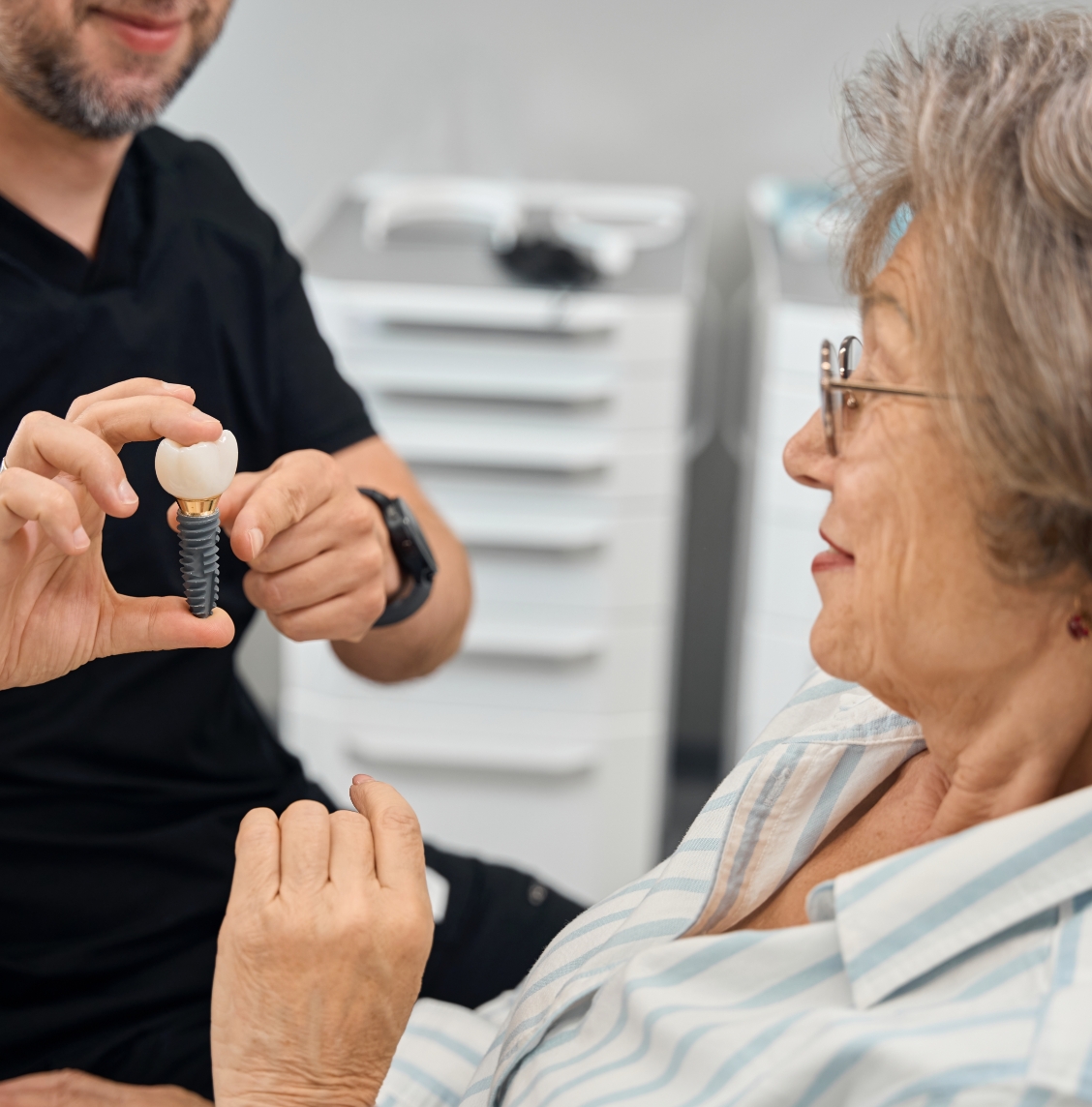
All-on-4 does what the name suggests. Four titanium implants are placed in the jaw, and a full arch of fixed teeth is secured onto them.
The clever part is the angle. The two implants at the front go in straight, while the two at the back are tilted, up to around 45 degrees. Tilting them lets your dentist anchor into the denser bone toward the front of the jaw and avoid the sinuses in the upper jaw and the nerve in the lower jaw. That is why grafting can often be skipped in cases that would otherwise need it.
The concept came out of work by Dr Paulo Maló with Nobel Biocare in the 1990s, with the first patients treated in 1998. It was designed specifically for people who had lost bone and would not have qualified for conventional implants without extensive rebuilding first.
Implants work through osseointegration, which simply means bone grows onto and around the titanium so it becomes anchored. Healthdirect describes roughly three months for that bone growth to happen, and it is the reason full-arch treatment happens in stages rather than all at once.
Typical candidates are people who:
- Have lost, or are about to lose, all the teeth in an arch
- Are tired of a denture that moves, clicks or rubs
- Have some bone loss but enough remaining bone in the right places
- Are in reasonable general health and either do not smoke or are willing to stop
- Want teeth that stay in
Being straight with you: this is surgery. It involves extractions in many cases, implant placement, healing time and a staged prosthesis. It is not right for everybody, and we will tell you plainly if your case would be better served another way. Uncontrolled diabetes, heavy smoking, active gum disease or insufficient bone all need addressing first, and sometimes they rule the option out.
For a full walkthrough of what the appointments involve, see our step-by-step guide to the All-on-4 procedure.
How dentures compare
Conventional dentures remain the most accessible option, and for some patients they are genuinely the right call.
They cost the least upfront by a wide margin, need no surgery, and can be made relatively quickly. If your health rules out surgery, or the budget for implants is simply not there, a well-made denture still restores your smile and lets you eat a reasonable range of food.
The trade-offs are real, though. Nothing anchors a denture, so it sits on the gums and can shift while you eat or talk. Many people quietly drop steak, apples and crusty bread from the menu, and feel more self-conscious in company than they would like. Adhesive takes the edge off it. It does not solve the underlying problem.
There is also a longer-term issue that patients are rarely warned about. Bone needs stimulation from tooth roots to maintain itself. Take the roots away, and the ridge gradually shrinks, a process called resorption. Your denture then stops fitting, which is why relines are needed periodically and replacement every several years.
There is a halfway house. An overdenture, properly called an implant-supported denture, clips onto two to four implants. You still take it out at night. What you get is a denture that stays put while you are using it, at a price well under a fully fixed arch. Cleveland Clinic puts it plainly enough: once the appliance is anchored to bone instead of sitting on gum, chewing and speaking get easier.
You can read about modern dentures on our service page.
How traditional implants compare
Traditional full-arch implant treatment is the more conventional route, and in the right mouth it is excellent.
Six implants, sometimes eight, occasionally more. They go in across the arch and the teeth are built onto them. The thinking is straightforward: more anchor points, less force on any single implant. For someone with good bone and a strong bite, that margin counts.
The costs of that thoroughness are time and money. More implants placed straight rather than angled often means grafting where bone has thinned, particularly in the upper jaw where sinus lifts may be needed. Grafting adds healing time before implants can even go in, so total treatment can stretch across many months. It is also the most expensive of the three options.
Plenty of cases still call for it. Heavy grinders are one. So is anyone who would rather have separate sections restored than a single continuous bridge. And where the bone volume is not there in the right places, four angled implants may not be a sensible plan.
Our single and multiple dental implants page covers the conventional approach, and if you are earlier in your thinking, we have written about whether implants are right for you.
How long does each option last?
Implants and the teeth attached to them have different lifespans, and conflating the two causes a lot of confusion.
The titanium implants themselves can last 20 years or more, and many placed decades ago are still working. Once bone has integrated, the implant is designed to stay.
The fixed bridge or prosthesis on top is the part that wears. It typically needs replacing after roughly 10 to 15 years, though this varies considerably with the material used, your bite and whether you grind. Published figures differ, so treat any single number with caution.
Dentures generally last about 5 to 10 years before they need replacing, with relines along the way as the ridge changes shape underneath.
Worth doing the arithmetic over a longer horizon. A denture costs far less at the start, but replacements and relines over 20 years add up, and the bone loss continues throughout. That does not make implants automatically cheaper, though it does change the comparison from the one most people make in the consultation room.
None of these figures is a guarantee. Longevity depends on your oral hygiene, whether you smoke, your bite and keeping up with reviews.
How much does All-on-4 cost in Australia?
All-on-4 is quoted per arch, not for your whole mouth. That single detail catches out most people comparing quotes online.
Across Australia, quotes for All-on-4 tend to land in the range of $20,000 to $40,000 per arch at 2026 prices. Having both the upper and lower jaw done takes you to roughly double that figure.
Several things move that number. Material is the big one, with acrylic at the lower end and zirconia at the top. After that it depends on whether teeth need removing first, whether any grafting is involved, whether you want sedation, and how much imaging and planning your case takes.
Then there is funding. Medicare will not cover implants for general patients. Healthdirect does note an exception for Veterans’ Gold or White Card holders, who may be able to claim. Private health extras with major dental cover will give you something back, but do not budget around it. The rebate is usually modest against a figure this size. We also offer payment plans, and our team can go through them with you.
Healthdirect also makes a fair point: make sure you know the full cost before starting, and ask your dentist for a written quotation. We itemise everything so you can see what is and is not included.
Prices are indicative and correct at the time of writing; your exact fee is confirmed at your consultation.
How to decide what is right for you
Start with these four.
- How much bone do you have? Nobody can eyeball this. A 3D scan gives the real picture. With plenty of bone, all three options stay on the table. Where a lot has gone, All-on-4 tends to come up, since tilting the back implants can sometimes get around a graft
- What does your general health say? Uncontrolled diabetes, some medications and healing conditions affect implant success. Smoking is the big one, and it raises the risk of implant failure, so we will talk honestly about it
- What is your budget, over what timeframe? Compare upfront cost, then compare across 15 to 20 years including replacements
- How much do you want teeth that stay in? For some patients this outweighs everything else. For others, removability is fine and the money is better spent elsewhere
Bring those answers to a consultation and the choice usually becomes obvious fairly quickly.
Why choose The Smile Collective for all-on-4 dental implants in Melbourne and Mornington Peninsula
Full-arch treatment is a big decision, and the planning matters as much as the surgery. We would rather spend the time getting your case right than rush you into a quote.
Our dentists are all Australian Dental Association members with vast general, oral surgical and orthodontic experience, and we are one of only a few practices on the Mornington Peninsula to offer All-on-4 dental implants and implant placement. Dr Ronak (Ron) Patel, BDS MJDF PGDip(Implants), is our Dental Implants Surgeon and a Practice Owner. He graduated from Guy’s, King’s and St Thomas’ Dental School in 2003, holds the Diploma of Membership of the Joint Dental Faculties at the Royal College of Surgeons of England, is an All-on-4 Plus Premium Provider, and was the first dentist in Australia certified to treat dental phobia. Dr Fady Goher, BDSc ADC MFDS Edinburgh, is a Director and Principal Dentist who completed a Postgraduate Diploma in Implant Dentistry in 2024 and his CBCT radiation licence in 2025. Dr Priya Patel, BDS (Honours), is a Director with advanced training in oral surgery and the management of anxious patients. Meet the wider team on our about us page.
Planning is done properly. Every full-arch case is mapped with CBCT 3D imaging so we can assess bone volume and place implants precisely, and our clinics also use CEREC same-day restorations, EMS Airflow Guided Biofilm Therapy and laser dentistry. If surgery makes you anxious, sedation and sleep dentistry is available.
You will find us at six centres: Greensborough, Mooroolbark, Oakleigh and Strathmore across Melbourne, and Mount Eliza and Mornington on the Mornington Peninsula.
Book a full-arch consultation at your nearest clinic: Greensborough | Mooroolbark | Oakleigh | Strathmore | Mount Eliza | Mornington
Book online or call your nearest Smile Collective centre.
Further reading
- All-on-4 Dental Implants at The Smile Collective
- What is the procedure for all-on-4 dental implants?
- Are Dental Implants the Right Choice for Missing Teeth?
- Dentures at The Smile Collective
Medical references
- Healthdirect Australia: Dental Implant
- Healthdirect Australia: Cost of Dental Care
- Therapeutic Goods Administration: Five Questions to Ask Before You Get a Medical Implant
- Better Health Channel (Victorian Government): Dentures
- Cleveland Clinic: Dental Implants
- Cleveland Clinic: Implant-Supported Dentures